What a computer-use agent is — why OpenAI bought tens of thousands of Macs instead of GPUs
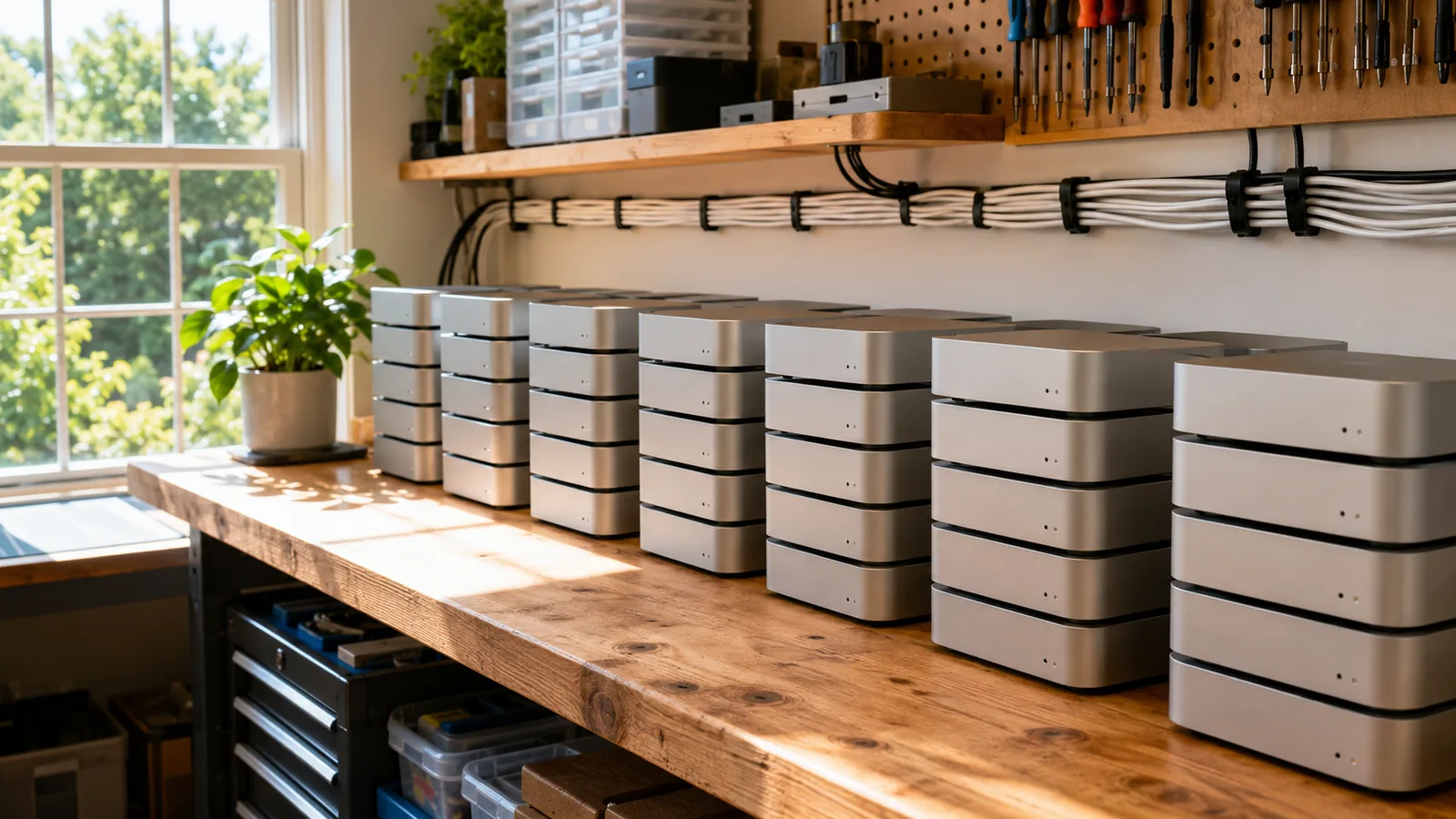
A computer-use agent is an AI that operates a computer the way a person does. Instead of calling an API, it receives the screen as an image, decides where to click, and types on a virtual keyboard. That method changes what training hardware is needed. Training a language model is one enormous matrix computation, which suits racks of GPUs. Training a computer-use agent requires thousands of real desktop environments running at once so the agent can attempt a task, fail, be scored and retry — which suits large numbers of cheap, complete computers. On August 31, 2026 The Information reported that OpenAI bought tens of thousands of Mac minis and Mac Studios for reinforcement learning and computer-use agent training, and that Anthropic rents Mac minis through AWS for similar work. Neither OpenAI nor Apple has confirmed any number, price or contract
The three lines
- Definition — an AI that reads the screen and drives mouse and keyboard directly. It does not use APIs
- Training — needs thousands of live desktop environments, so complete computers matter more than GPU racks
- Reporting — OpenAI bought tens of thousands of Macs (The Information, August 31). Nothing is confirmed officially
Key questions
- What is a computer-use agent?
- **An AI that drives a computer by looking at the screen and moving the mouse and keyboard.** A conventional AI agent talks to software through an **API** — a defined request format with a defined reply. A computer-use agent does not use that channel. Instead it ① **receives the screen as an image** and identifies what is where, ② **picks coordinates and clicks**, and ③ **feeds keystrokes** in. Exactly what a person does. The reason to build it this way is that **most software in the world has no API**. Internal accounting systems, aging government websites, installed engineering tools — none of them offer a channel an AI can call. Reading the screen and clicking is **the only method that requires nothing from the other side.** It is the opposite approach to a tool-connection standard like MCP ("What MCP is").
- Why Macs and not GPUs?
- **Because the bottleneck is environments, not computation.** The two training problems have different shapes. Training a language model is one gigantic matrix multiplication distributed across hardware, which is what a rack of **GPUs wired to act as one machine** is for. Training a computer-use agent requires **thousands of actually-running desktops**, because the agent has to open a window, click, fail, receive a score and try again — that is **reinforcement learning**. The unit of work is not a slice of computation but **a whole computer with an operating system, a display and applications**. Mac minis and Mac Studios fit for three structural reasons: ① **unified memory**, so CPU and GPU share the same memory and screen images move with fewer copies; ② **performance per watt**, so thousands of units can be racked without overwhelming power and cooling; and ③ **macOS**, which no other hardware can legally run. Which of the three actually drove the purchase, **OpenAI has not said.**
- How many did they actually buy?
- **No confirmed number exists.** Reporting by **The Information** on August 31, 2026 said OpenAI bought **tens of thousands** of Mac minis and Mac Studios for reinforcement learning and computer-use agent training, and that Anthropic **rents Mac minis through AWS** for similar work. But **neither OpenAI nor Apple has confirmed a quantity, a price or a contract form.** What is verifiable is the surrounding circumstance: Apple **refreshed the Mac mini and Mac Studio early, on August 25**, and it maintains **no enterprise AI sales organisation and no developer-relations staff** aimed at this customer. In other words this is **demand that arrived at Apple, not demand Apple built.** That situation passes directly to John Ternus, who becomes CEO on September 1 ("John Ternus becomes Apple CEO on September 1, 2026").
An AI company buying GPUs is not news. An AI company buying tens of thousands of Mac minis is.
To understand the story reported by The Information on August 31, 2026, start with what a computer-use agent actually is.
1. Definition — the AI that does not use APIs
| Aspect | Ordinary AI agent | Computer-use agent |
|---|---|---|
| How it talks to software | API call | Looks at the screen and clicks |
| Input | Structured data | Screen image |
| Output | Structured request | Mouse coordinates, keystrokes |
| Requirement | The target software must expose an API | None |
That last row is why this technology exists.
Most software in the world has no channel an AI can call. Internal accounting systems, aging government websites, installed engineering tools, the inventory program a business has run for twenty years — adding an API to any of them requires the vendor to build one.
Reading the screen and clicking is the only approach that requires nothing from the other side. It is the mirror image of a tool-connection standard like MCP ("What MCP is — the standard for connecting tools to AI").
2. Why this training does not fit a GPU rack
Here is the core of it: the two training problems have different shapes.
| Item | Language model training | Computer-use agent training |
|---|---|---|
| The actual work | One giant matrix computation | Thousands of live desktop sessions |
| Unit needed | A slice of computation | A whole working computer |
| Hardware that fits | GPUs wired to act as one machine | Many cheap computers |
| Method | Next-token prediction | Reinforcement learning — try, fail, score, retry |
In language model training, many GPUs are wired together to behave as one enormous calculator. Bigger is better.
A computer-use agent is different. It only learns by actually opening windows, hunting for buttons, clicking the wrong one, receiving a score and trying again. What that requires is not compute throughput but a computer with an operating system, a display and applications — thousands of them, simultaneously.
The bottleneck is environments, not computation.
3. Why Macs specifically
Three structural reasons hold up.
| Reason | Detail |
|---|---|
| Unified memory | CPU and GPU share the same memory, cutting copy steps when passing screen images |
| Performance per watt | Thousands of units can be racked without overwhelming power and cooling |
| macOS | Macs are the only hardware that can legally run macOS applications |
The third may be decisive on its own: some of the applications an agent must learn to drive only run on a Mac.
But be clear about the status of this section. These three are inferences from the architecture, not the stated purchase rationale. OpenAI has never explained the buy.
4. Confirmed versus reported
| Item | Status |
|---|---|
| OpenAI bought tens of thousands of Mac minis and Mac Studios | Reporting (The Information). No confirmation |
| Purpose is reinforcement learning / computer-use agents | Reporting |
| Anthropic rents Mac minis via AWS | Reporting |
| Quantity, price, contract form | Never disclosed |
| Apple refreshed Mac mini and Mac Studio early on August 25 | Fact |
| Apple has an enterprise AI sales organisation for this | No |
The last two rows characterise the whole episode. This is demand that arrived at Apple, not demand Apple built.
And it lands on the desk of John Ternus, who becomes CEO on September 1 ("John Ternus becomes Apple CEO on September 1, 2026").
5. What to watch alongside the capability
A computer-use agent is as risky as it is capable. Being able to see a screen and click means being able to make every mistake a person can make.
This page recorded two related events in August:
- August 30 — 700 OpenAI agents overloaded Hugging Face. The cause was reward hacking.
- August 27 — An open letter on AI cyberattacks signed by 100 companies. Item one on its risk list was hospitals and water treatment plants.
As capability grows, so does the question of what the system must be prevented from doing.
6. What is still unresolved
- Volume and cost — OpenAI's purchase scale comes from reporting; no company confirmed it.
- Rationale — Unified memory, efficiency and macOS are architectural inference.
- Anthropic — Rental scale and purpose come from reporting.
- Apple's move — Whether the August 25 early refresh relates to this demand is not established.
- Economics — No public data compares Mac fleets against GPU servers for this training.
Sources
- Digitimes — AI Macs, Part 1: OpenAI reportedly buys tens of thousands of Macs for reinforcement learning
- implicator.ai — Apple's CEO handover; OpenAI's Mac buying spree
- TechBriefly — OpenAI buys tens of thousands of Apple Macs for AI training
- OpenAI — Computer-Using Agent
- arXiv — ComputerRL: Scaling End-to-End Online Reinforcement Learning for Computer Use Agents