How to watch the Perseids — a telescope makes it worse, not better
Perseid meteors appear anywhere in the sky and last about a second, so a wide unaided field of view catches far more of them than binoculars or a telescope, which magnify a tiny patch you are unlikely to be looking at
The three lines
- No gear needed — meteors scatter across the whole sky, so wider vision beats magnification
- After midnight is better, because your side of Earth turns into the direction of travel
- 2026's peak falls around midday on August 13 KST, in a year with almost no moonlight interference
Key questions
- What is the Perseid meteor shower?
- Earth passes through a trail of debris left by a comet at the same point in its orbit each year. The debris hits the atmosphere at tens of kilometres per second and burns, which is what you see. The Perseid trail comes from comet Swift-Tuttle, and the shower is named for Perseus because the meteors appear to radiate from that constellation. It runs from mid-July through late August and peaks in mid-August.
- How many will I actually see?
- Forecasts run 50–100 per hour under ideal conditions, but that figure assumes the radiant overhead and a fully dark sky. In a city you will see far fewer. Light pollution is the biggest variable, moonlight the second. 2026 is forecast as a favourable year for moon conditions, which means even faint meteors stay visible.
- Why is a telescope a disadvantage?
- Because a meteor's position is unpredictable and it lasts about a second. A telescope magnifies a very small patch of sky, so the odds of a meteor crossing that patch are low, and by the time you refocus it is over. Binoculars have the same problem. The human eye covers more than 100 degrees of view, and for this object that width is the performance spec.
- Do I need to find the radiant?
- No — staring at it is counterproductive. Meteors near the radiant travel almost straight toward you, so their trails look short. Looking somewhat away from Perseus gives you longer, more striking streaks. How much sky is in your field of view matters far more than which direction you face.
The most common mistake people make watching a meteor shower is preparing too well. They bring binoculars, open a star-chart app to locate the radiant, stare at that patch for half an hour, and conclude that the shower was overhyped.
All three of those choices reduce how many meteors you see.
1. Why unaided eyes win
Meteor watching is the opposite of every other kind of observing.
| Target | What helps | Why |
|---|---|---|
| Planets, nebulae | More magnification | Fixed position, observable for minutes |
| Meteors | More field of view | Unpredictable position, ~1 second duration |
A telescope enlarges a very small patch of sky. A meteor may not cross it, and if it does, it is finished before you can react. Binoculars fail the same way.
The human eye spans over 100 degrees. For this phenomenon that width is the instrument. Using no equipment is not a compromise — it is the correct choice.
The second factor is dark adaptation. Your eyes take 20–30 minutes to adapt fully, and a single glance at a phone screen undoes much of it. More viewing sessions are ruined by screen light than by cloud.
2. Timing — why after midnight
The post-midnight rule is geometry, not folklore.
Earth rotates while it orbits. Around local midnight, your position rotates onto the leading side of Earth's motion — the side ploughing into the debris stream. It is the windshield-versus-rear-window effect: more particles arrive on the forward face.
At the same time, the radiant in Perseus climbs higher as the night goes on. When the radiant sits near the horizon, a large share of meteors burn out below your sightline.
- Early evening — low rates, but occasionally a long, dramatic earthgrazer skimming the horizon
- Midnight to pre-dawn — the productive window
- Just before twilight — the radiant is highest but the sky is brightening
The 2026 peak is forecast for around midday on August 13 Korean time. Since that falls in daylight in East Asia, the nights on either side are the practical windows. Meteor showers ramp up and down over days rather than switching on at a single instant.
3. Location and kit
| Item | Recommendation | Reason |
|---|---|---|
| Location | Away from streetlights and buildings | Light pollution dominates the count |
| Posture | Lying down or a reclining chair | A craned neck gives out in 30 minutes |
| Direction | Somewhat away from the radiant | Longer visible trails |
| Optics | None | Narrower field = fewer meteors |
| Clothing | Long sleeves even in summer | Pre-dawn cold and insects |
| Light | Red torch | White light destroys dark adaptation |
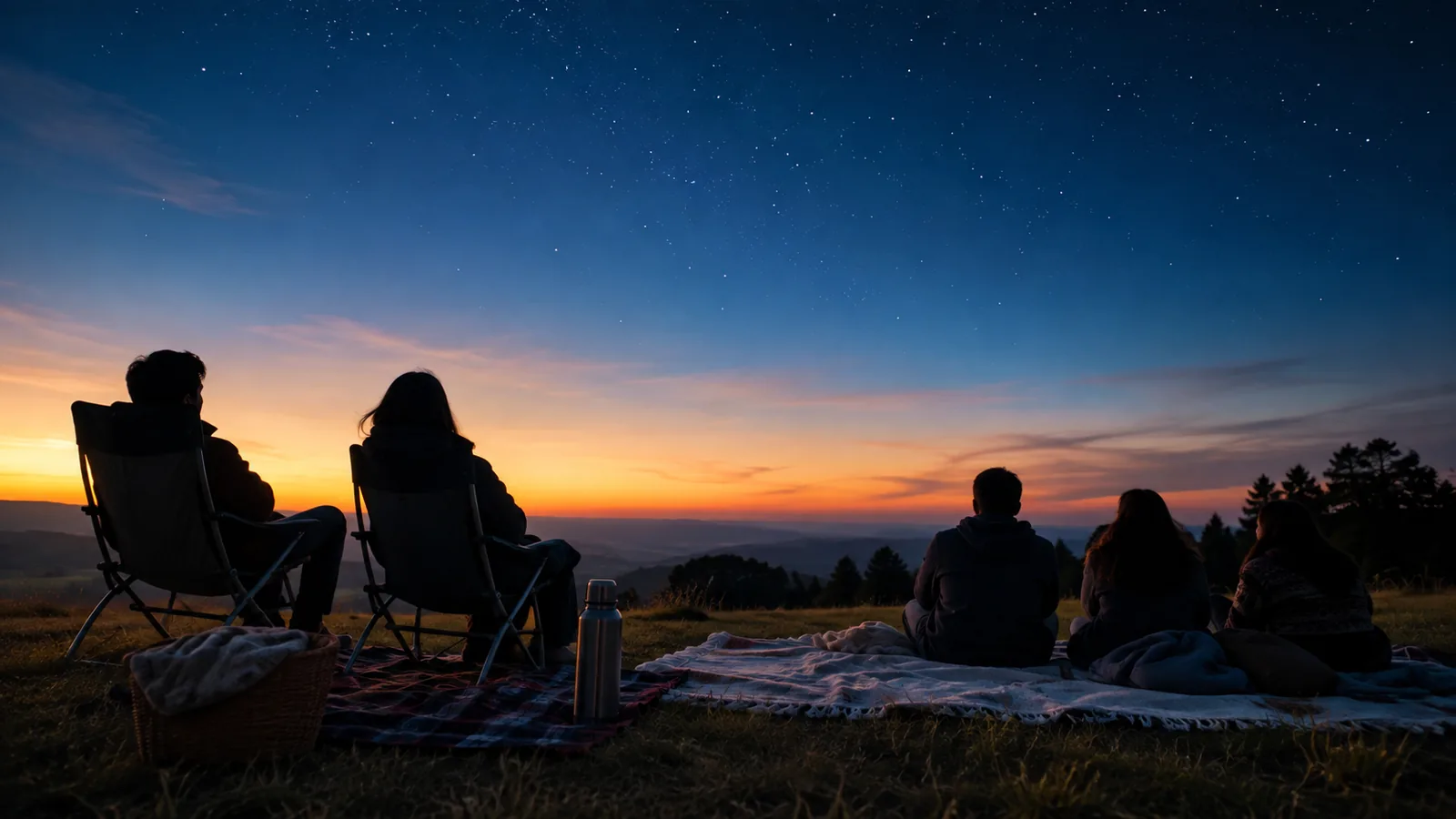
The most underrated item is posture. Standing with your head tilted back, you will quit before the rates pick up. This is an activity that rewards 30-plus continuous minutes of sky, which makes a mat or a reclining chair the single most useful piece of equipment.
Many local observatories run public viewing sessions during the peak. For a first attempt, that beats driving into the mountains alone — you get a dark site and someone who can tell you what you are looking at.
4. Three persistent myths
"Meteors fall like rain." The name misleads. 50–100 per hour averages to one or two a minute, and they arrive in clumps with five-minute gaps between. Most of the experience is waiting.
"100 per hour, so a city should still be decent." That figure is the zenithal hourly rate: radiant overhead, sky fully dark. Urban skies erase everything but the brightest meteors.
"No moon means it will be too dark to see anything." Backwards. Moonlight brightens the sky and washes out faint meteors. A moonless year is the best case, and 2026 is forecast to be one.
5. What remains unverified
This guide cannot tell you the one thing that decides the night: the weather. Meteor watching succeeds or fails on cloud cover far more than on forecast rates, and summer air often carries enough moisture to cut transparency even when the sky looks clear.
Peak timing differs by agency. The August 13 midday figure is the Korea Astronomy and Space Science Institute's forecast and can differ by several hours from international estimates — though since rates change gradually, a few hours rarely changes your plan.
The hourly forecasts themselves miss in both directions every year. The debris stream is not uniformly dense, so some years overperform and some underperform. The number is an expectation, not a promise.