How Korea's budget gets decided — why a ministry announcement is not a settled number
In South Korea the government drafts the budget and the National Assembly reviews and finalizes it. Article 54 of the Constitution requires the government to submit its budget bill 90 days before the fiscal year begins and the Assembly to pass it 30 days before, which makes December 2 the passage deadline. Article 33 of the National Finance Act moves the submission deadline earlier, to 120 days before the fiscal year — early September — so the legislature has more time to review. Between submission and passage come the president's policy address, standing committee preliminary reviews, the Special Committee on Budget and Accounts, and the budget adjustment subcommittee where amounts are actually cut and added
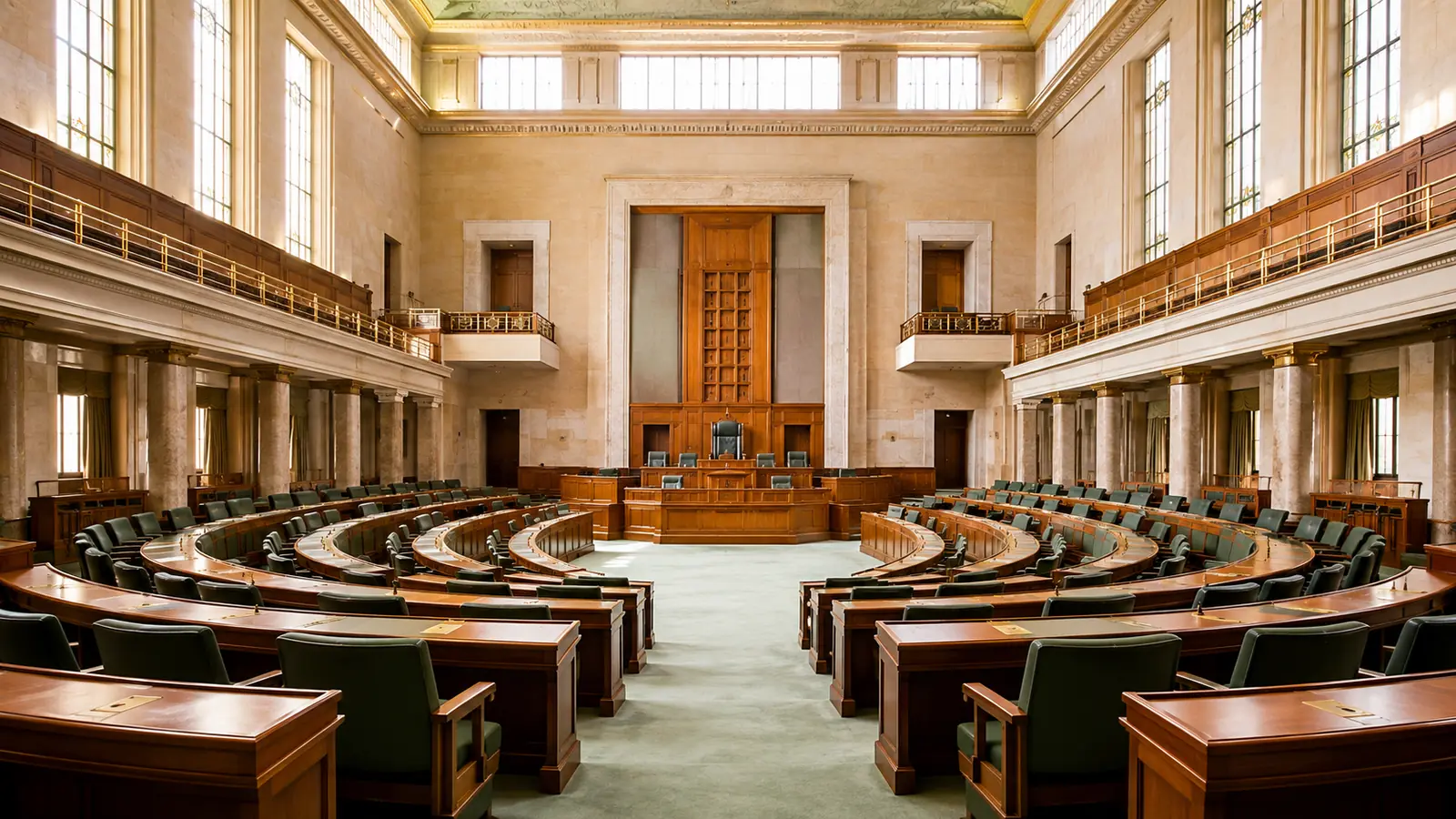
The three lines
- Structure — The government drafts, the National Assembly reviews and finalizes. Article 54 of the Constitution
- Deadlines — Submission 120 days before the fiscal year under statute (early September); passage 30 days before (December 2)
- Key stage — Amounts actually change in the budget adjustment subcommittee. A government announcement is a starting point
Key questions
- Who decides Korea's budget?
- **The government drafts it and the National Assembly finalizes it.** Article 54(1) of the Constitution states that **"the National Assembly shall deliberate and decide upon the national budget bill."** Drafting authority sits with the executive; finalizing authority sits with the legislature. The sequence: the Ministry of Planning and Budget issues **budget formulation guidelines** each spring, confirmed by the Cabinet; ministries submit **budget requests** under those guidelines; the fiscal authority negotiates with each ministry to settle amounts, producing **the government bill**; the bill passes the Cabinet and receives presidential approval before going to the Assembly. **Everything up to that point is 'formulation'; what follows is 'deliberation.'** The "X trillion won for Y" headlines that appear in August and September are almost always the output of the formulation stage — **a proposal**.
- What are the deadlines for submission and passage?
- **Early September to submit, December 2 to pass — and the two deadlines come from different laws.** Article 54(2) of the Constitution requires the government to submit **90 days before the fiscal year begins** and the Assembly to pass **30 days before**. With a fiscal year starting January 1, that puts the constitutional submission deadline at **October 2** and passage at **December 2**. In practice submission is earlier, because **Article 33 of the National Finance Act moves it to 120 days before the fiscal year**. That statute originally said 90 days too; it was **amended in 2013 to 120 days to give the Assembly more review time.** So the structure is one where **a statute demands an earlier deadline than the constitutional floor**. For the 2027 budget, the government said it would submit by **September 2, 2026**.
- What happens once it reaches the National Assembly?
- **Four stages, and the money actually moves in the second to last one.** ① **Policy address** — the president explains the bill's purpose in plenary session. ② **Standing committee preliminary review** — each committee examines the budget of the ministries it oversees; these findings are preliminary. ③ **Special Committee on Budget and Accounts** — the whole bill is examined again, through comprehensive policy questioning and department-by-department review. ④ **Budget adjustment subcommittee** — **this is where amounts are cut and added.** A small group of members decides increases and decreases item by item; this is the body Korean coverage refers to simply as "the subcommittee." One rule shapes all of it: **increases require the government's consent.** Article 57 of the Constitution provides that the Assembly may not, without the executive's consent, increase the amount of any expenditure item or create a new one. **Cuts it can make alone; increases it cannot.**
- What if December 2 passes without a vote?
- **The bill does not lapse, but two mechanisms engage.** The first is **automatic referral**: under the National Assembly Act, if the Special Committee on Budget and Accounts has not finished by November 30, the budget bill is **automatically referred to the plenary** the next day. It forces a floor vote even when review runs late. The second is the **provisional budget**. Article 54(3) of the Constitution provides that if no budget is passed by the start of the new fiscal year, the government may spend **on the basis of the previous year's budget** until one is, limited to categories such as constitutional bodies, statutory obligations and continuing costs of already-approved projects. **Government does not stop, but nothing new can start.** In practice the provisional budget is rarely used; passage usually comes in late December.
August and September in Korea are dense with ministry budget announcements. "43.3 trillion won for young people." "A new grant, created."
Those numbers are not final.
The government drafts. The National Assembly decides. Four months sit in between.
1. The division of labor — Article 54
"The National Assembly shall deliberate and decide upon the national budget bill." (Constitution, Article 54(1))
| Actor | Power |
|---|---|
| Government | Formulation — drafts it |
| National Assembly | Deliberation and decision — settles it |
That one line is the frame for everything below.
2. Two deadlines, two laws
The deadlines confuse people because there are two sources.
| Source | Requirement | Date (fiscal year starting January 1) |
|---|---|---|
| Constitution, Art. 54(2) | Submission: 90 days before | October 2 |
| National Finance Act, Art. 33 | Submission: 120 days before | early September |
| Constitution, Art. 54(2) | Passage: 30 days before | December 2 |
The Constitution sets a floor. A statute may demand an earlier date.
The National Finance Act said 90 days too, until it was amended in 2013 to 120 days to give the legislature more review time.
For the 2027 budget, the government said it would submit by September 2, 2026.
3. Inside the executive (formulation)
| When | Stage |
|---|---|
| Spring | Ministry of Planning and Budget issues formulation guidelines, confirmed by Cabinet |
| Spring to early summer | Ministries submit budget requests |
| Summer | Fiscal authority negotiates amounts with ministries |
| August-September | Government bill settled → Cabinet → presidential approval |
| Early September | Submitted to the National Assembly |
For 2027, the guidelines were confirmed in Cabinet on March 30, 2026 and ministry requests were due May 31.
The "X trillion won" headlines of August and September are the output of this stage — the government's proposal.
4. Inside the legislature (deliberation)
| Order | Stage | What happens |
|---|---|---|
| 1 | Policy address | The president explains the bill's purpose in plenary |
| 2 | Standing committee preliminary review | Each committee reviews its ministries' budgets (preliminary) |
| 3 | Special Committee on Budget and Accounts | The whole bill re-examined; policy questioning and department review |
| 4 | Budget adjustment subcommittee | Where amounts are actually cut and added |
| 5 | Plenary vote | Final |
Stage 4 is the one that matters. A small group of members decides item-by-item increases and decreases — the body Korean coverage calls simply "the subcommittee." It is why budget stories cluster in December.
5. What the Assembly cannot do alone — increase
Cuts and increases follow different rules.
| Direction | Assembly acting alone? |
|---|---|
| Cut | Yes |
| Increase or create a new item | Government consent required |
The Assembly may not increase the amount of an expenditure item or create a new one without the executive's consent — a provision understood to be Article 57 of the Constitution.
That is why budget review in Korea takes the shape of a negotiation over cuts. Adding requires agreement.
6. If December 2 passes
Missing the deadline does not void the bill. Two mechanisms engage.
| Mechanism | Effect |
|---|---|
| Automatic referral | If the Special Committee has not finished by November 30, the bill goes automatically to plenary the next day |
| Provisional budget | If no budget passes by the new fiscal year, spending continues on the previous year's basis for limited categories |
Provisional spending is limited to constitutional bodies, statutory obligations and continuing costs of already-approved projects.
Government does not stop, but nothing new can start. In practice the provisional budget is rarely used; passage usually lands in late December.
7. How to read an announcement
Three checks:
- Is this a government proposal or an enacted budget?
- What start date is stated? Programmes requiring legislation alongside the budget can slip.
- Does it say "up to"? If so, it does not mean everyone receives that amount.
The child allowance and birth grant announced on August 28, 2026 should be read the same way. They are covered in "Korea's new child allowance and birth grant, July 2027."
8. Related coverage
- "Korea's new child allowance and birth grant, July 2027" — an announcement awaiting this process
- "What the Future Response Fund is" — changing where revenue is routed
- "What changed in Korean daily life in 2026" — programmes that completed this process
- "The 1.4 billion won property tax deduction" — the revenue side
9. What was not confirmed
- Automatic referral — the National Assembly Act article and wording were not checked against the text.
- Consent for increases — understood to be Article 57; not checked against the original.
- Sequence and timing — summarizes customary practice, not checked against the Assembly Act.
- Provisional budget scope — summarizes the constitutional provision; itemized categories not confirmed.
- Delay statistics — years in which passage missed the deadline were not reviewed.
- Total spending — the 2027 total expenditure figure has not been officially announced.
Sources
- Wikipedia (Korean) — Article 54 of the Constitution of the Republic of Korea
- Korean Law Information Center — Constitution of the Republic of Korea, Article 54
- LBOX — National Finance Act, Article 33 (Submission of the budget bill to the National Assembly)
- Ministry of Planning and Budget — 2027 budget formulation and fund management plan guidelines confirmed
- Korea.kr — Next year's budget formulation guidelines confirmed
- Sejung Ilbo — Bill would move the government's budget submission deadline from 120 days to 90 days
- Korea.kr press release — 2027 core youth budget announced