What is behind-the-meter (BTM) power — why AI data centers are building power plants in their own backyards
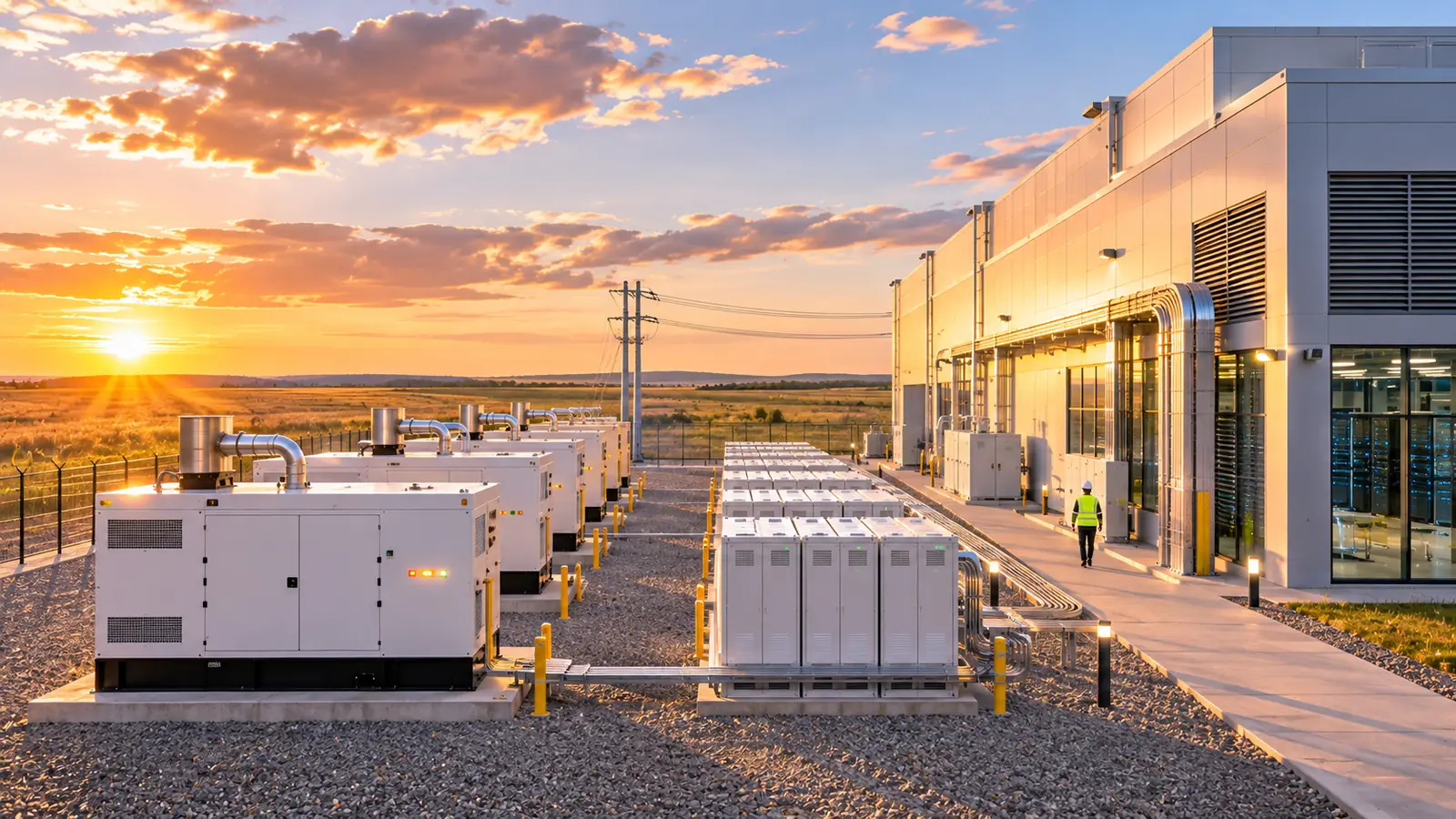
Behind-the-meter (BTM) power is electricity generated on the customer's side of the utility meter — on or next to the site — instead of being bought from the grid. AI data centers are turning to it because new grid connections can take years; Morgan Stanley estimates US AI data centers face a roughly 38 GW power shortfall through 2028. The main tools are gas reciprocating engines, aeroderivative turbines and large gas turbines, usually with batteries. Anthropic's reported $3.4 billion purchase of 1.7 GW of generators in September 2026 is the biggest example.
The three lines
- Meaning — power made inside the meter, on your own site, bypassing the grid
- Why — grid queues of years; about 38 GW US AI shortfall through 2028 (Morgan Stanley)
- Cost — fuel, emissions and permits; large turbines over 90% booked for 2028
Key questions
- what does behind the meter mean
- **Power generated on the consumer's side of the utility meter and used on site, avoiding grid transmission charges and connection queues.** | | Front of the meter (grid) | Behind the meter (BTM) | |---|---|---| | Generation | Distant power plants | On or next to the site | | Path | Grid → meter → consumer | Generator → consumer | | Owner | Utility | Consumer or specialist supplier | | Examples | Nuclear, large thermal, wind farms | Factory CHP, rooftop solar, data center gas generators |
- why do data centers build their own power
- **Because grid connections can take years, and AI companies can't wait.** | Reason | Detail | |---|---| | Queues | Transmission and substation upgrades take years | | Shortfall | ~38 GW for US AI data centers through 2028 (Morgan Stanley) | | Transmission costs | Off-grid operation can avoid $100–350 per MW-day (Latitude Media) | | Local opposition | Fears data centers raise residents' power bills | | Speed | Switching on months earlier is a competitive edge |
- types of on-site power for data centers
- **Large gas turbines, aeroderivative turbines and gas reciprocating engines, often paired with batteries.** | Type | Feature | Supply (Feb 2026) | |---|---|---| | Large gas turbines | Efficient, large | 90%+ booked for 2028, 70%+ for 2029 | | Aeroderivatives | Fast start, mobile units exist | Less constrained | | Reciprocating engines | Fast ramping, modular | BTM systems ~65% booked for 2028, ~33% for 2029 | | Batteries | Absorb fluctuations | Paired with generators |
- downsides of behind the meter power
- **Operators carry fuel costs, emissions permits and their own backup, without the grid's reserve.** | Downside | Detail | |---|---| | Fuel | Gas price swings borne directly | | Emissions | Carbon and air pollution; permits needed | | Reliability | Islanded sites need redundant capacity | | Equipment | Multi-year turbine backlogs | | Community | Noise and emissions opposition |
Behind-the-meter (BTM) power is electricity made on the inside of the meter. Normally power is generated at distant plants and travels over the grid to a building's utility meter. The grid side is "in front of the meter"; the user's side is "behind" it. BTM is power generated on your own site and used there — rooftop solar and factory cogeneration are both examples.
This old utility term has become central to AI. Data centers are building generation next to their buildings instead of waiting for the grid. The Financial Times reported on November 8, 2026, that Anthropic bought 1.7 GW of gas generators for about $3.4 billion from OnePWR, a turnkey BTM supplier.
1. Grid versus behind the meter
| Front of the meter | Behind the meter | |
|---|---|---|
| Path | Plant → grid → substation → meter → user | Generator → user |
| Owner | Utility | User or specialist supplier |
| Costs | Tariffs including transmission | Equipment plus fuel |
| Connection wait | Years for grid upgrades | Months to two years with equipment in hand |
| Backup | The whole grid | Must be self-provided |
There are two flavors. Most projects stay grid-connected and use on-site generation as a bridge until the connection arrives, then as backup or peak supply. Fully "islanded" sites with no grid tie are still rare, Latitude Media reports, because all redundancy must be built in.
2. Why AI data centers are going BTM
| Pressure | Detail | Source |
|---|---|---|
| Shortfall | About 38 GW for US AI data centers through 2028 | Morgan Stanley (secondary) |
| Transmission | Off-grid avoids $100–350 per MW-day | Latitude Media |
| Politics | Governors-elect in Texas, Georgia, Ohio pledged data center limits | Fortune |
| Bills | Concern data centers raise residents' power prices | Multiple reports |
Politics now adds urgency. After the November 3 midterms, a key argument against data centers is that they push up local electricity bills; generating your own power partly answers it. Examples are piling up: Anthropic's 1.7 GW order; OpenAI's Stargate site in Abilene, which pairs the grid with on-site gas turbines; and China's Galaxy campus in Ulanqab, which links 420 MW of the operator's own wind farms by a dedicated line, showing BTM need not mean gas.
3. The equipment, and the turbine crunch
| Type | Pros | Cons | Supply (Feb 2026) |
|---|---|---|---|
| Large gas turbines | High efficiency, scale | Long lead times, costly | 90%+ booked for 2028 |
| Aeroderivative turbines | Fast start, mobile | Less efficient | Less constrained |
| Reciprocating engines | Fast ramping, modular | Lower efficiency, many units | ~65% booked for 2028 |
| Batteries | Smooth fluctuations | Not a standalone source | Paired with generators |
Per Jefferies research cited by Latitude Media, gas reciprocating engines can run 40,000–80,000 hours before major maintenance and support a data center for more than 11 years at an 80% capacity factor. Global supply of turbines and close substitutes is expected to rise more than 80% by 2030 to over 125 GW a year, about 46 GW of it from BTM-focused makers. Taking over an existing order, as Anthropic did, skips the queue.
4. The trade-offs
| Cost | Who bears it |
|---|---|
| Fuel price swings | Operator |
| Emissions and permits | Operator and community |
| Redundant backup | Operator |
| Grid cost-sharing | Other ratepayers, some argue (disputed) |
BTM is buying time with money and emissions. Once the grid catches up, these plants may retreat to backup duty, but in today's race they are likely to keep spreading.
FAQ
Is rooftop solar behind the meter? Yes — it is generated and used on the customer's side of the meter.
How is BTM different from backup generators? Data centers have long had diesel backups for outages. BTM plants run as a primary source day to day.
Is a BTM site cut off from the grid? Usually not; most remain grid-connected and use on-site power as a bridge or supplement.
Our reports on Anthropic's generator deal and on China's 800V DC data center show the two approaches side by side, and our explainer on data center moratoriums covers the political backdrop.
Sources
- Latitude Media — Is the gas turbine bottleneck solving itself? (2026-02-18)
- Bisnow — Anthropic Pays $3.4B For Gas Turbines To Power Its Data Centers (2026-11)
- CNBC — Anthropic secures $3.4 billion generator deal for AI data centers, FT reports (2026-11-08)
- SemiAnalysis — We visited China's Stargate in Inner Mongolia (2026-11)
- Crypto Briefing — Morgan Stanley estimates AI data centers face a 38 gigawatt power shortfall through 2028