Glacial lake outburst floods (GLOF) — 388 in the Himalaya, and no warning
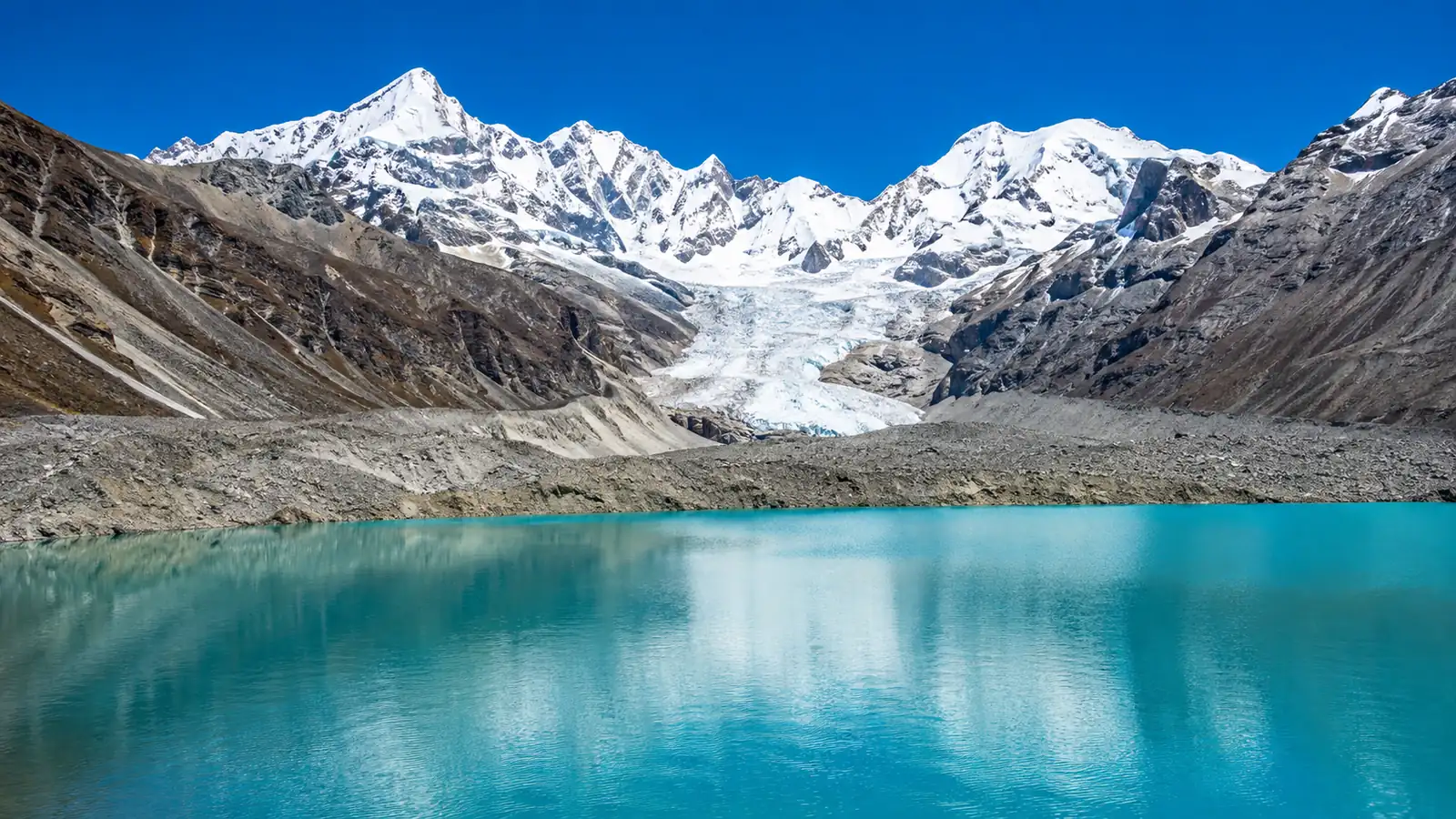
A glacial lake outburst flood, or GLOF, is what happens when the natural dam holding back a glacier-fed lake fails and sends a large volume of water downstream with almost no warning. That dam is not concrete but a moraine — rock, gravel and soil bulldozed into place by the glacier, with ice buried inside it — which makes it inherently weak. More than 388 such events are documented in the Himalaya-Karakoram region, most often in the Karakoram. The commonest triggers are ice avalanches and extreme rainfall, with earthquakes a third. Behind all of it, glacier retreat keeps creating and enlarging the lakes
The three lines
- Definition — the natural dam holding a glacial lake fails and the water arrives all at once
- Why weak — the dam is a moraine of loose rock, sediment and buried ice, not engineered fill
- Scale — 388+ recorded across the Himalaya-Karakoram, most frequently in the Karakoram
Key questions
- What is a glacial lake outburst flood and why is it dangerous?
- **It is what happens when the natural dam holding back a glacier-fed lake gives way and the water comes down at once.** The danger is **time**, not volume. A rain flood raises a river over hours or days; a GLOF starts the moment the dam fails, leaving almost no warning downstream. And what arrives is not clean water. It picks up rock, gravel and soil from the failed dam and then from the valley itself, becoming a **debris flow** with far more mass and destructive power than the lake alone. More than **388** such events are documented in the Himalaya-Karakoram, most frequently in the **Karakoram**, then the Central and Eastern Himalaya.
- Why do glacial lake dams fail so readily?
- **Because of what the dam is made of.** Most glacial lakes are held by a **moraine** — the ridge of rock, gravel and soil a glacier pushes ahead of and beside itself. It has three weaknesses. ① It is **unconsolidated**: deposited material, not engineered fill. ② It contains **buried ice**; when that melts, voids open and the structure settles. ③ It **thins over time** as warming continues. So a moraine dam is not simply a structure that might fail one day — it is a structure that gets **weaker every year**.
- Why are these floods increasing in the Himalaya?
- **Because the lakes themselves are multiplying and growing.** The Himalaya-Karakoram cryosphere is retreating rapidly under climate change. Where a glacier pulls back, meltwater collects and **new lakes form**; existing ones enlarge. Each year there are more targets for a trigger to hit. The triggers are several: most commonly an **ice or snow avalanche** falling into the lake and generating a wave, and **extreme rainfall**. **Earthquakes** add a third path — the Himalayan states sit in seismic zones IV and V, where quakes routinely set off landslides that then destabilise moraine dams.
A glacial lake outburst flood is a problem of time more than volume.
A rain flood lifts a river over hours or days. A GLOF begins at the instant the dam fails, and downstream there is almost nothing to warn with.
1. What fails
| Feature | Engineered dam | Glacial lake dam |
|---|---|---|
| Material | concrete or compacted fill | moraine — rock, gravel and soil pushed by the glacier |
| Interior | designed structure | contains buried ice |
| Over time | maintained | weakens as the ice melts |
| Failure warning | instrumented | usually none |
The third row is the point. A moraine dam does not hold steady — it degrades every year as internal ice melts and voids open.
2. What pulls the trigger
| Trigger | Mechanism |
|---|---|
| Ice or snow avalanche | A mass falls into the lake and generates a wave that overtops or erodes the dam |
| Extreme rainfall | Raises the level fast enough to overtop |
| Earthquake | Shakes the dam directly, or starts a landslide that enters the lake |
| Glacier retreat | Not a trigger but the condition — it creates and enlarges the lakes |
The two commonest are ice avalanches and extreme precipitation. In seismic zones IV and V, the earthquake chain is not rare either.
3. What arrives is not water
| Stage | What moves |
|---|---|
| 1 | The lake bursts |
| 2 | The collapsed moraine itself is entrained |
| 3 | Valley floor and slope material is scoured and added |
| 4 | A debris flow — heavier than water, and slower to stop |
Which is why the volume measured downstream is often far larger than the lake's own capacity. The literature records events that began at a small Himalayan lake and became transborder floods.
4. Where, and how many
| Region | Frequency |
|---|---|
| Karakoram | highest |
| Central Himalaya | next |
| Eastern Himalaya | next |
More than 388 GLOFs are documented across the Himalaya-Karakoram, mainly from moraine- and ice-dammed lakes. The count varies with the study period and classification.
5. How this relates to Nepal, August 2026
The distinction is easy to lose.
| Event | Origin |
|---|---|
| GLOF | An existing glacial lake's dam fails |
| Nepal-Tibet, August 26, 2026 | The glacier itself collapsed, sending ice, water, rock and mud down |
By the United States Geological Survey's confirmation, August 26 was a glacial collapse and debris flow, not formally a GLOF.
But it manufactured the conditions for one. Debris carried down the valley dammed a river at the border, creating a barrier lake that is still filling. If that natural dam fails, a second flood runs onto ground already destroyed — structurally the same event as a GLOF. The human toll is covered in "Nepal flood: 626 dead as of August 29."
6. Can it be prevented — three approaches
| Approach | Method | Limit |
|---|---|---|
| Lower the lake | Channels or siphons drain water in advance to cut pressure | Construction at altitude is hard and expensive |
| Early warning | Level and vibration sensors alert downstream | Useless without power and comms; warning time is short |
| Land-use rules | Do not build villages or plants on the valley floor | In mountains, the valley floor is the only flat ground |
The third dilemma is the heart of the hazard. Hydropower must follow the river; settlements need flat ground. In mountain country, the places that satisfy both are the places the water goes.
7. Frequently asked
If glaciers melt, isn't the problem water scarcity, not floods? Both, on different clocks. Near term, meltwater enlarges lakes and raises GLOF risk. Long term, a vanished glacier means less dry-season flow. Two problems on different time axes.
Is a barrier lake the same as a glacial lake? No. A glacial lake is impounded by glacier-derived material; a barrier lake is impounded by a landslide or debris flow. Both, though, are held by natural, unengineered dams, so the failure risk behaves alike.
How fast does it arrive? It depends on the valley, but in narrow steep gorges rises of several metres within 30 minutes are reported. In the August 2026 Nepal event the Trishuli reportedly rose as much as 9 metres in 30 minutes.
Can satellites predict it? Satellites can watch lakes grow, which is how hazard inventories get built. When a dam fails is far harder to forecast, and actual warning still depends on ground sensors.
8. What we could not confirm
- 388 — a literature count that shifts with period and classification.
- Classification — whether August 26, 2026 is formally logged as a GLOF is unsettled.
- Inventory — the number of hazardous lakes and early-warning coverage were not verified.
- Terminology — the barrier-lake and moraine-dammed-lake terms are used inconsistently across sources.
Sources
- ICIMOD — Glacial Lake Outburst Floods
- npj Natural Hazards (Nature) — Glacial lakes and GLOFs in a warming Himalaya-Karakoram region
- GeoJournal (Springer) — Glacial lake outburst floods (GLOFs): causes, modeling, and mitigation in the Indian Himalayan region
- Wikipedia — Glacial lake outburst flood
- PMC — Transition of a small Himalayan glacier lake outburst flood to a giant transborder flood and debris flow
- Al Jazeera — Nepal-Tibet floods: What is a glacial collapse, how common is it?