What is a semiconductor foundry? $46.7 billion a quarter without a chip of its own — vs fabless and IDM
A semiconductor foundry manufactures chips that other companies design. It does not sell chips under its own name; it rents out its fabs and process technology. TSMC, founded in Taiwan in 1987, created this pure-play model and earned US$46.72 billion in revenue in Q3 2026 alone without a single product of its own. Companies that design but outsource manufacturing — Nvidia, Apple, AMD, Qualcomm — are called fabless; companies that do both — Samsung Electronics, Intel — are integrated device manufacturers (IDMs). Samsung and Intel also run foundry businesses for outside customers.
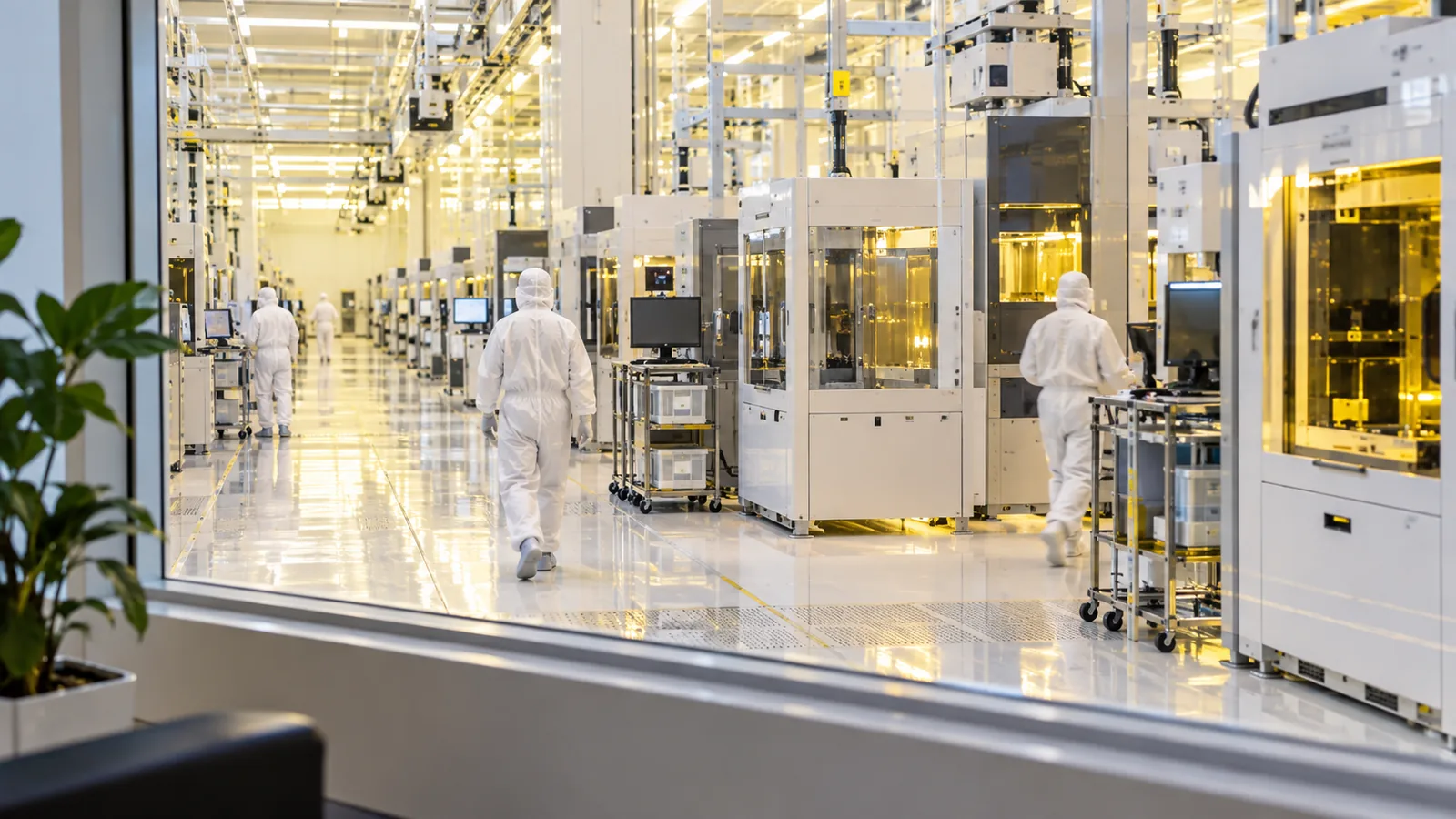
The three lines
- Definition — contract manufacturing of chips designed by others; no own-brand chips
- Structure — fabless (design only), foundry (make only), IDM (both); Samsung and Intel are IDMs with foundry arms
- Scale — TSMC Q3 2026 revenue US$46.72B; 79% from 7nm-and-below nodes
Key questions
- What does a semiconductor foundry do
- **It manufactures chips designed by other companies.** | Type | Does | Examples | |---|---|---| | Fabless | Design only | Nvidia, Apple, AMD, Qualcomm | | Foundry | Manufacture only | TSMC, GlobalFoundries, UMC | | IDM | Both | Samsung, Intel, SK hynix (memory) | | IDM + foundry | Own chips + contract work | Samsung, Intel |
- Fabless vs foundry
- **Fabless firms design without factories; foundries run factories without designing.** | | Fabless | Foundry | |---|---|---| | Fabs | None | Yes, tens of billions of dollars each | | Core asset | Design teams, IP | Process tech, yield | | Revenue | Chip sales | Wafer manufacturing fees | | Risk | Supply disruption | Capex burden, demand swings | | Example | Nvidia | TSMC |
- TSMC vs Samsung Foundry
- **TSMC is pure-play; Samsung is an IDM with a foundry division.** | | TSMC | Samsung Foundry | |---|---|---| | Model | Pure-play | Division inside an IDM | | Competes with customers? | No | Its own chips can compete with customers' | | Leading edge | 2nm at 8% of Q3 2026 revenue | 2nm GAA in production | | Origin | Founded 1987 | Split out as a business unit in 2017 |
One of the world's most valuable chip companies sells no chips under its own name. TSMC reported Q3 2026 revenue of US$46.72 billion and net income of NT$763.06 billion. Nvidia GPUs, Apple's iPhone processors and AMD CPUs all come out of TSMC fabs, yet none carries TSMC's name. That is what a foundry is.
1. Three kinds of chip companies
| Type | Design | Make | Examples | How it earns |
|---|---|---|---|---|
| Fabless | ✓ | ✗ | Nvidia, Apple, AMD, Qualcomm, Broadcom | Sells chips it designs |
| Foundry | ✗ | ✓ | TSMC, GlobalFoundries, UMC | Charges to make wafers |
| IDM | ✓ | ✓ | Samsung, Intel, SK hynix | Makes and sells its own chips |
"Fab" is short for fabrication plant; fabless literally means "without a factory". Until the 1980s most chipmakers were IDMs because designing required owning a fab. When TSMC launched in 1987 promising to make only other people's chips, it became possible to build a chip company without a factory — Nvidia is one result.
2. Why the industry split — fabs got too expensive
| Reason | Detail |
|---|---|
| Capex | A leading-edge fab costs tens of billions; TSMC's 2026 capex plan was US$60-64B as of July |
| Process difficulty | 2nm and 3nm need years of yield learning |
| Scale | Fabs must run full; pooling many customers keeps them busy |
| Specialization | Designers focus on design, manufacturers on process |
3. Pure-play vs IDM foundries
| Pure-play (TSMC) | IDM foundry (Samsung, Intel) | |
|---|---|---|
| Own products | None | Yes (phone chips, CPUs) |
| Customer trust | "We never compete with customers" | Fear that designs could leak to in-house product teams |
| Strength | Neutrality, diversified customers | One-stop memory + foundry + packaging |
| Recent moves | 2nm volume, advanced packaging | Samsung split foundry into a unit in 2017; Intel set up Intel Foundry in 2024 |
Samsung pitches a turnkey offer combining HBM memory, foundry and packaging. AI chips need HBM bonded next to the GPU, so doing all three in one place can be an advantage.
4. What foundry results tell you
| Metric | How to read it | TSMC Q3 2026 |
|---|---|---|
| Revenue | How much customers actually ordered | US$46.72B, above guidance |
| Node mix | Size of leading-edge demand | 7nm and below 79%; 2nm 8% |
| Gross margin | Pricing power vs new-node costs | 66.4% |
| Capex | Bet on demand 2-3 years out | US$60-64B for 2026 (July) |
Because a foundry only books revenue after customers design and order, its results are one of the earliest mirrors of AI chip demand. But they measure the maker's side; the finances of the data-center firms buying the chips — such as CoreWeave — need to be read separately.
5. FAQ
| Question | Answer |
|---|---|
| Is a foundry the same as an OEM? | Similar contract manufacturing; in chips, wafer-level contract manufacturing is called foundry |
| Is memory made in foundries? | Mostly no — DRAM and NAND are made by IDMs such as Samsung, SK hynix and Micron |
| Korean foundries? | Samsung's foundry division, DB HiTek and others |
| Does a foundry design anything? | Not customer chips, but it supplies process design kits (PDKs) and IP |
6. What remains open
- Market share: varies by tracker, so not stated.
- Samsung 2nm: no official yield or customer data.